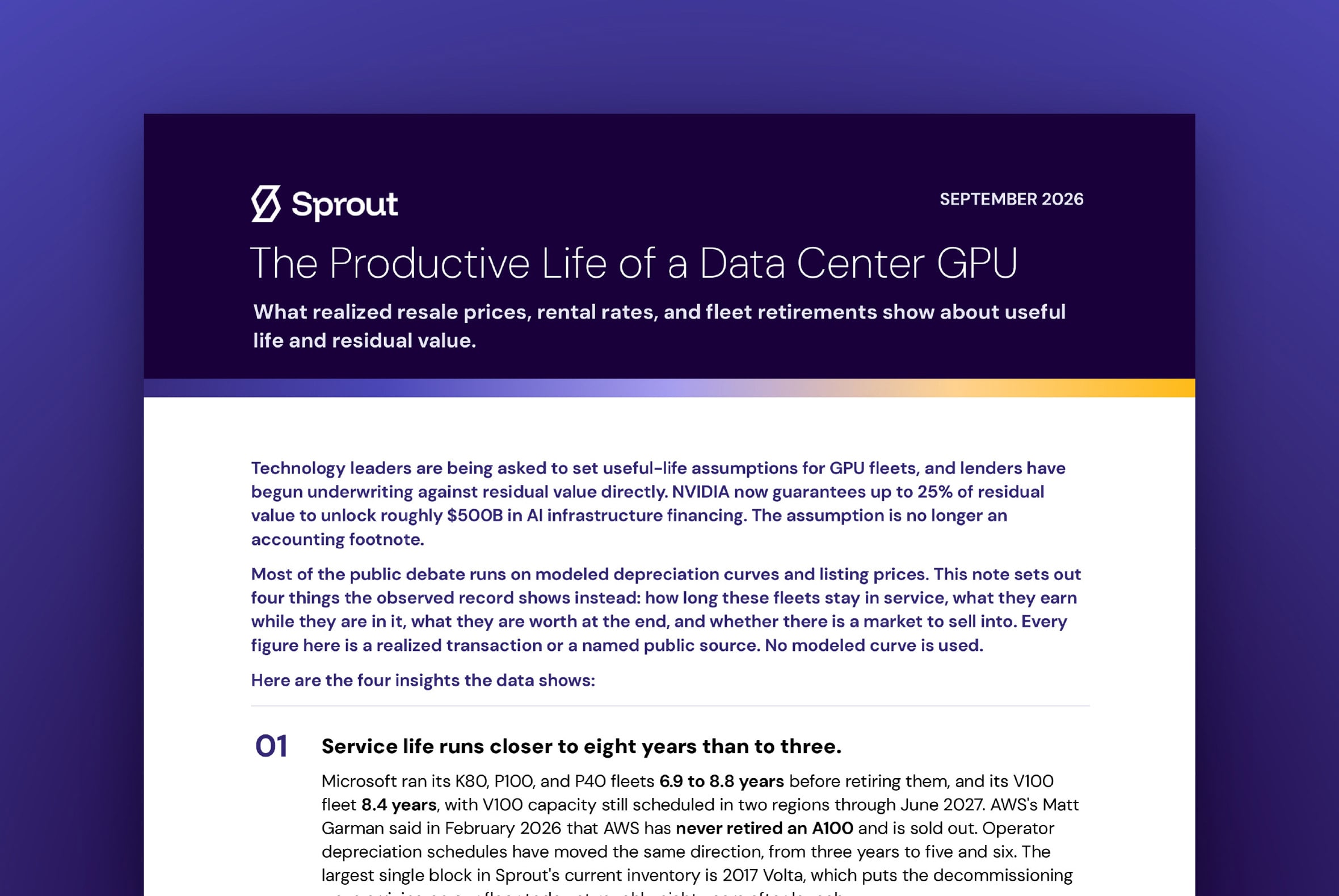

As organizations accelerate AI initiatives, they're under pressure to modernize infrastructure while controlling capital spending. GPU clusters, high-performance storage, networking equipment, and supporting infrastructure require significant investment, forcing CIOs and IT leaders to justify every dollar. But while most conversations focus on reducing costs or finding new funding, they often overlook an important source of capital that already exists.
Every infrastructure refresh unlocks value. As enterprise servers, storage arrays, networking equipment, and other assets leave production, organizations can recover millions of dollars through resale, refurbishment, and redeployment. Too often, however, that value is treated as the final accounting entry in an IT asset disposition (ITAD) project instead of as a resource that can help fund what's next.
That's where Sprout, the intelligent technology lifecycle platform, creates opportunity. Rather than treating value recovery as the end of the lifecycle, Sprout helps organizations capture, manage, and reinvest recovered value as part of an ongoing infrastructure strategy. The result is a continuous funding model that helps offset future AI investments, reduces pressure on capital budgets, and changes the economics of infrastructure planning.
In traditional models, retirement is the finish line
For years, teams have treated IT asset disposition as the operational end of a hardware lifecycle. Equipment is retired, data is destroyed, and assets are either sold or recycled. If there are any proceeds, they’re recorded, and that’s it: the project closes.
According to this approach, recovery is a single, separate event that happens outside the lifecycle—not a continuous process that helps shape future acquisitions. That may have worked fine when infrastructure refreshes were relatively predictable, but AI has changed the equation.
AI infrastructure makes the old financial model harder to sustain
Organizations aren't simply replacing aging desktops anymore. Instead, they're investing in high-value AI infrastructure that includes GPU clusters, high-performance storage, networking equipment, and specialized compute environments. These assets present substantial capital investments, and when retired, they often retain significant market value.
Most organizations recover at least some of that value, but the issue is where does that value go next? Too often, the recovered funds disappear into general budgets. Months later, infrastructure teams return with a request for new capital to fund refresh initiatives, lifecycle services, or modernization projects – and it’s like starting from square one.
CIOs and leaders of IT finance and procurement are being tasked with finding new capital to fulfill these requests, instead of taking advantage of the value they already have.
A modern operating model: credits create a strategic reserve
Within leading enterprises, teams are approaching AI infrastructure differently. Instead of only asking how much they can recover, they’re also asking how they can preserve recovered value to fund their next AI infrastructure refresh and ongoing lifecycle management. Refurbishment, redeployment, and strategically timed resale all contribute to that strategic reserve.
With Sprout, recovery credits can first offset the cost of lifecycle services, then support future hardware purchases, refresh programs, or broader modernization initiatives. Instead of funding each phase of the lifecycle independently, a continuous financial loop stretches existing infrastructure value.
Every dollar that can be reinvested from existing infrastructure value is one less dollar that has to come from a new capital request. With a more intentional approach to recovered value, infrastructure retirement can support future investment instead of being the end of the line.
Recovery only becomes strategic when it’s visible
One of the first steps to managing recovered value as a strategic reserve is gaining visibility. Infrastructure and finance leaders need to understand lifecycle program costs, recovered value, and available credits. Without that transparency, teams will struggle to incorporate recovered value into planning, procurement, and budgeting decisions.
Sprout's approach is built around making these connections visible. Through SmartERP, Sprout’s technology-driven lifecycle platform, customers gain a consolidated financial view of decommissioning and disposition activities, including recovered value and credits.
Visibility changes the conversation between IT, procurement, and finance. Instead of evaluating lifecycle initiatives based only on gross program costs, leaders can see the true net investment after recovered value has been applied. Infrastructure credits become visible funding resources.
How Sprout's model goes beyond traditional ITAD
Traditional ITAD wasn't designed for AI infrastructure economics.
Sprout's recovery optimization process maximizes recoverable value through intelligent refurbishment, resale, and redeployment while tracking every recovered dollar, down to the component level. That combination consistently delivers 20–40% higher recovery rates and more credits.
Instead of treating disposition services, recovery activities, and future infrastructure as separate events, organizations can manage lifecycle investments through a streamlined single PO model. All ITAD activity draws against one blanket PO – no per-disposal approvals necessary – eliminating procurement friction and finance delays.
The story of a leading SaaS enterprise illustrates how Sprout’s credits-as-a-strategic reserve benefits teams. By combining resale optimization with strategic redeployment, this enterprise recovered about $20 million in resale value—and avoided another $10 million in CapEx through internal redeployment, creating a net financial impact of roughly $30 million. Numbers like these are proof that enterprises can achieve cost-neutrality or better.
For a social media giant, undergoing two time-sensitive major data center refreshes, existing credits funded the expansion in a decommissioning engagement, while resale proceeds offset return logistics. For the center’s operations manager, it was a significant win-win: no new net expense, and no need for multiple POs.
Recovered money creates more strategic options and less financial strain
The high cost and implementation speed of AI infrastructure will continue to exert financial pressure on decision makers. Enterprises will continue seeking to support refreshes while limiting requests for more capital. Against the backdrop of this high-stakes reality, the most successful organizations will recognize that some of their next infrastructure budget already exists within current IT lifecycles.
These teams are managing recovered value as a strategic reserve that funds lifecycle decisions, using it to support financial flexibility, reduce procurement friction, and improve lifecycle ROI. With Sprout, leading enterprises can treat recovered value as infrastructure capital rather than proceeds to the general ledger.